
Wednesday, July 3, 2013
Videos

Wednesday, July 18, 2012
New Wordpress site!
Monday, April 9, 2012
SSG 10 Below Glove Review
 As
part of my Christmas gift from my lovely trainer and boss, I got a pair
of SSG’s 10 Below gloves. After two months of use, I feel that I can
now write a review on them. I did not realize until yesterday that they
are marketed as riding gloves and not work AND riding gloves. Which
greatly changes my perspective on them.
As
part of my Christmas gift from my lovely trainer and boss, I got a pair
of SSG’s 10 Below gloves. After two months of use, I feel that I can
now write a review on them. I did not realize until yesterday that they
are marketed as riding gloves and not work AND riding gloves. Which
greatly changes my perspective on them.Here is the information given on them from SSG’s website (www.ssgridinggloves.com):
“Due to the success of our summer weight SSG® Digital glove with the best grip and durability of any riding glove, we engineered this 10 Below™ Equestrian glove with the digital palm. In addition the glove features a spandura back, a waterproof membrane, thinsulate lining and inside that our exclusive polar fleece. As good as it gets in a winter riding glove. 4 Layers of warmth!”
The design of the gloves is absolutely ideal. First off, they fit me! I had been searching high and low for small, insulated work gloves and could not find ones in my size. There’s nothing worse than a glove that fall off of your hand or that had extra long fingertips that get caught in everything. They are slightly grippy. They have a knit wrist meaning that bits of hay and straw do not get into the glove, which I love! They are insulated nicely, not too thinly, but not too thick as to make them awkwardly bulky. Another thing that I love is that they are waterproof! No more wet and cold hands after breaking ice off from water troughs or draining hoses. While riding, my hands stayed warm for a majority of the time. I still had frozen fingers on those really cold days and haven’t found a glove that keeps my fingers warm 100% of the time. Just stick a hand warmer in each on and they’re good for putting out round hay bale on the tractor and doing chores in frigid temps or a blizzard.
I used these gloves not only for riding. I had them on my hands ten hours a day, six days a week. I opened gates, carried buckets, lunged horses, tacked up, carried straw and hay bales, ice chipped, mucked stalls, fought with hoses, fixed fence, did snaps and adjusted buckles. If I had used them solely for riding, I doubt they would have fallen apart at the one and a half month mark.

It started off with some wear spots on the fingers. Then the stitching on the extra patch of layer on the index fingers came loose. That started catching in everything from girth buckles to gate snaps. I finally just ripped it off. Then the thumbs area started developing a hole. At first it was just the top layer, then the waterproof membrane ripped as well and pretty soon all four layers were shot.
As warm winter riding gloves, these are great! I highly recommend them for riding in weather below thirty degrees. I still think your hands would be cold in ten below weather, but I did not get the chance to test that out, thankfully.

I hope that SSG will make a more durable pair of gloves just like these, waterproof and with the knit wrists for working around the barn. They would be worth the money and I would purchase them in a heartbeat. If you’re looking for a pair of gloves to double for both work and riding, I would pass on these as they will not last you even one season. They are sold as riding gloves for a reason. Even so, they have the best pair of winter gloves I have owned.
Sunday, February 19, 2012
Paralyzer
When
showing dressage, you start off with a pretty simple set up,
bridle-wise. It’s a headstall, a noseband, and a snaffle bit. Once you
are ready to perform at 3rd
Level, you are suddenly presented with a choice. If you so wish, you
are permitted to use a double bridle. Although it is not mandatory under
USDF rules, it is widely accepted that once you hit the “upper levels”
(A vague term that in this day and age ranges from 3rd
Level through Grand Prix, but for future reference when I say “upper
level” I literally mean the FEI levels of Prix St. George through Grand
Prix.) you will ride with a double bridle. However, if you plan on
showing internationally, at CDI events, a double bridle and spurs are
compulsory.
Of course, with me having a tiny rebellious streak, I would LOVE to show at the Grand Prix Level in just a snaffle, win the class, and have an appreciative audience. Just to be different. (That same part of me wants to show in a bareback dressage class. Wouldn’t that be fun?!) To my knowledge, I’ve never seen that. I’ve seen people ride all the movements in just a snaffle and even bitless, but it’s another thing to do that in competition and score well. A student of my current trainer showed Prix St. George very successfully last year with her horse wearing a snaffle bridle. Their cool meter is pretty high.
Back to my explanation of “the double” as we fondly refer to it. Although I wouldn’t use the word “fond” in my case, but we’ll touch on that in a paragraph or so. The double bridle has a snaffle with smaller rings, called a bridoon, and a curb bit. Because it has two bits, you then have two reins. We could go on about the whys and hows, but that’s the point I need to make here. The point is, the double bridle works differently from your normal bridle. You do not have as much side to side suppling because you now have a curb which works with leverage. You can be much more subtle with your aids.
With that difference in mind, here’s what happens to me when I ride a horse with a double bridle. I sit there on their back and feel like my arms are not my own. I do what I normally would do with a normal snaffle bridle, but without the same effect. I try to do more in an effort to get any sort of positive response from the horse, or I stop doing anything at all. My arms become like dead limbs, simply grasping the reins with my failing hope. The double bridle paralyzes me. It makes me feel like I cannot ride. Because of who I am, when I feel like I cannot ride, I then feel entirely useless to the world. It is an unpleasant cycle.

What do I do to make myself more comfortable with the double? I posed this question to myself and the answer I came up with is: Use the double bridle more! Ride in it every chance you get to with instruction. Learn to use it properly. I’ve only been testing this answer out for a week or so. I can’t say that I’ve had any real breakthrough yet, but I won’t give up hope just yet. I want to become proficient and at ease when using the double bridle. I want this, so I’m going to work at it. I will not remain paralyzed.
Is there something in riding that paralyzes you now or used to paralyze you? Also, I’m curious to know if that word is looking weirder to you now.
Of course, with me having a tiny rebellious streak, I would LOVE to show at the Grand Prix Level in just a snaffle, win the class, and have an appreciative audience. Just to be different. (That same part of me wants to show in a bareback dressage class. Wouldn’t that be fun?!) To my knowledge, I’ve never seen that. I’ve seen people ride all the movements in just a snaffle and even bitless, but it’s another thing to do that in competition and score well. A student of my current trainer showed Prix St. George very successfully last year with her horse wearing a snaffle bridle. Their cool meter is pretty high.
Back to my explanation of “the double” as we fondly refer to it. Although I wouldn’t use the word “fond” in my case, but we’ll touch on that in a paragraph or so. The double bridle has a snaffle with smaller rings, called a bridoon, and a curb bit. Because it has two bits, you then have two reins. We could go on about the whys and hows, but that’s the point I need to make here. The point is, the double bridle works differently from your normal bridle. You do not have as much side to side suppling because you now have a curb which works with leverage. You can be much more subtle with your aids.
With that difference in mind, here’s what happens to me when I ride a horse with a double bridle. I sit there on their back and feel like my arms are not my own. I do what I normally would do with a normal snaffle bridle, but without the same effect. I try to do more in an effort to get any sort of positive response from the horse, or I stop doing anything at all. My arms become like dead limbs, simply grasping the reins with my failing hope. The double bridle paralyzes me. It makes me feel like I cannot ride. Because of who I am, when I feel like I cannot ride, I then feel entirely useless to the world. It is an unpleasant cycle.

Rocket& his snaffle, Sarah& Renee rocking the double bridle!
What do I do to make myself more comfortable with the double? I posed this question to myself and the answer I came up with is: Use the double bridle more! Ride in it every chance you get to with instruction. Learn to use it properly. I’ve only been testing this answer out for a week or so. I can’t say that I’ve had any real breakthrough yet, but I won’t give up hope just yet. I want to become proficient and at ease when using the double bridle. I want this, so I’m going to work at it. I will not remain paralyzed.
Is there something in riding that paralyzes you now or used to paralyze you? Also, I’m curious to know if that word is looking weirder to you now.
Monday, February 13, 2012
Heart to heart!

When I was sixteen, I was working at the barn a few afternoons each week in exchange for riding privileges and a weekly riding lesson. I rode a good variety of horses and one day I was told that I could ride one that I hadn’t ridden before. She was a cute little chestnut mare called Miss Take (Tah-Kay). She had been at the barn for a few years already, but not everyone could ride her. I was excited that my BO/trainer thought I was good enough to sit on her. I tacked Miss Take up and we went out to the infield of the racetrack. I found a fairly flat area without many rocks and rode her around. The next time I had a lesson, I rode Miss Take. I remember that I couldn’t steer her in a straight line or turn her when I wanted to. I had gotten used to riding the other horses. But she wasn’t like them. We could only canter on a large circle about forty meters in diameter. If I tried to go straight, she fell out of the canter. We never got the right lead canter on the first try. I was pleased if we got it on the third try. And she spooked at everything!
By this time in my life, I had loved and lost my favorite horses. I had surrendered myself to the fact that I would not be a horse owner until I was “grown-up” financially stable on my own. I knew that would take a number of years. I figured I’d be in my mid-twenties by the time I would finally be able to purchase my own horse. I didn’t like that idea, but I lived with it. Miss Take quickly became my favorite horse to ride and was the horse that I rode most often. I told myself time and time again to not let myself bond with her. I didn’t want the heartbreak I knew I’d feel once she left, too. So I kept my distance the best I could. Which would have been fine and dandy had that worked. It didn’t. I was falling head over heels for that mare.
A year later, when I was seventeen, my BO pulled me aside after a rewarding lesson on Miss Take. She regretfully informed me that she was going to be putting Miss Take up for sale. The economy was down and feed was up. Miss Take was only being ridden by me and one other woman. Both of us worked at the barn in exchange for lessons. Miss Take was not earning her keep. “But…” my BO said. She wanted me to buy Miss Take and she would offer her to me for much less than her market value. The other woman had already said that she couldn’t afford Miss Take at this time. I was Miss Take’s last chance at staying at the barn. I went home that afternoon and spoke to my parents. I sat on their bed and explained the situation to them and I did something that I never ever do. I cried. I didn’t have enough money to buy her. I had half. My parents said that they would match my half. I said that I would work off most of the board and pay for vet bills with my own money.
I thought about all that Miss Take had experienced in her life. I thought about the many hands and barns she had passed through, always being a mistake for them. I didn’t want that to happen to her anymore. She had done so much for me and my riding confidence that I felt she didn’t deserve that. I wanted to tell her that it would all be okay and that she would be able to life out the rest of her life in security. I couldn’t stand being there when my mom went to the barn with me a couple days later and sat down for a talk with my BO. I scurried around the barn, holding back tears as I busied myself with chores. I caught a few words and partial sentences here and there. They called me over to the dusty picnic table and told me that they had reached an agreement. The next day I was signing a paper that stated that I was a horse owner. At age seventeen I had my first horse! I felt like I was dreaming the best dream of my life. The funny thing was that she was almost the exact opposite of the horse I had prayed for every single night when I was younger. I wanted a dark bay gelding, some sort of Morgan/QH/TB/Arabian/best of all breeds about eight years old. Instead I got a chestnut mare that was in her late teens and to top it all off, she had a pink nose! That was something I generally didn’t like.
It took a while for us to bond. I think we were both so used to going from human to human and horse to horse that we had a hard time opening up again. After six months, people at the barn began to comment on how Miss Take seemed to have “blossomed” now that she was a one-person horse. My horse. I entered her in the next dressage show and wrote down her new show name without hesitation. Accidentally In Love. It described out relationship perfectly. Oh and there’s also this:

I had been riding Miss Take for a few months when a girl around eight or nine years old pointed to the spot on her belly and said that it was in the shape of an upside down heart. Until that moment, I hadn’t noticed the shape of her spot at all. What with the heart, the meaning behind her barn name, and our accidental road to becoming horse and owner, I thought the show name was fitting.
As I turned Miss Take out into the pasture she lived in with the herd, I watched her walk over to the water trough and drink her fill. I swung her halter and lead rope over my shoulder. She let a few droplets of water dribble down her chin and pointed an ear towards me. “You’re going to be my forever horse,” I told her. “You won’t ever have to bounce from home to home again. You deserve it because of what you have been for me. I’m going to take care of you until the very end. I promise. And I always keep my promises.”
Since I celebrate February 14th as Miss Take’s birthday, I thought a post about how we ended up together would be perfect. Miss T will be either eighteen or nineteen this time around, according to our guesstimation, As another fun fact, the woman who used to ride Miss Take, but couldn’t afford to buy her is now one of the lovely ladies who is leasing Miss Take while I am away doing this internship! I love seeing how things like that fall into place. Speaking of which, Miss Take is the first horse that her two leasees have shown. Last Saturday they had much success and brought home many blue ribbons and great scores. Oh and remember how I said that I didn’t used to be able to steer Miss Take? By the time that I had to leave for this internship, Miss Take and I were schooling 2nd Level movements and had debuted at that level at a horse show! I could gush on and on and brag all night long, but I won’t because I know I am extremely biased. I don’t claim that Miss Take is the best horse in the world, but she is the best horse in the world for me.

Monday, February 6, 2012
Turn it Up!
What am I getting at? Well, I’ll get to it; just give me a few more paragraphs.
I think all riders, pros and ammies alike, no matter the discipline, want an obedient horse. They want the horse to be sensitive to their aids. Not over reactive. Not dull. They want to communicate with the horse and say, “Hey, let’s canter now!” and have their horse willingly move off into that gait. No one trains their horse to take off cantering only when the aid has been applied several times in succession, each time more forceful than the last. “Well, he should hopefully canter the fifth time that you kick him…” That’s not fun for anyone involved.
The first clinic that I rode in was with Paula Lacey. I was excited because not only had I heard great things about her as a teacher and been judged by her in the past, but because my horse and I were debuting at 2nd Level and I was anxious to know what she thought of us as a team and what she would have us work on. Imagine my surprise when she didn’t start the lesson with bells and whistles. She asked us to halt and then walk. Paula came over to us and gently pushed my calf against my horse’s side. This was how I was to ask for the walk from the halt. No more than that. If my horse didn’t listen to that then BANGBANG went my legs and SLAP went the whip. She had us do this very simple transition over and over until my horse moved off of a light application of my leg. We didn’t even worry about the roundness. I didn’t try to get it, but as our transitions improved, I noticed that my horse was on the bit. (And isn’t that what true roundness is? Being on the bit a.k.a. on the aids?) Once we got the transitions prompt and obedient, we had laid the foundation for the rest of the work. By the end of the lesson, we were doing haunches-in on a diagonal line which could also be described as baby steps of trot half pass, something my horse and I had only just begun to learn.

Us after our clinic lesson!
Have you ever been accused of kicking your horse too much? I have! I don’t know how I fell into the habit but it happened gradually until the horse so dull that I had to literally kick it every stride to keep it going. I was kicking and kicking with little to no result. I was nagging and the horse had tuned my chattering out. I compare it like this. There’s a friend of yours, right? He has hearing aids and you’re yelling at him so you can converse. So you shout “CAN YOU TURN THOSE THINGS UP?” and he does. Then you are able to continue on with your conversation using a normal tone of voice. Yet somehow when we’re riding we keep yelling at our horses (Always figuratively… right?) and never bother to turn up their sensitivity to our aids and at last we reach the grand finale where we look like we’re flailing around atop our steed to just get them to walk on. It’s a very attractive picture. Not.
I can’t promise that I’ll be able to tell you how to fix this. Each horse has different knobs to turn in a different manner and order. For example, you and your horse could be the complete opposite of what I have been describing. Your horse might take off without any application of your aids and if that’s the case, your course of action would be to make the horse less reactive. So here’s a disclaimer about how you’d be best off having your trainer tell you what to do. It’s true, but since I’m writing this blog post, I’m going to tell you what I do anyways.
- Halt.
- Ask the horse to walk by gently closing your inner calves around their barrel.
- If no response, ask nicely once more.
- If still no response, give a big hard kick or whip whack or both simultaneously. Be careful not to pull on the reins while doing this.
- Once horse walks, praise. Even if the horse goes from the halt to a trot or canter, still praise like he/she won the Kentucky Derby.
- Repeat as often as necessary until you are the fly the horse shivers away. And for those of you who don’t get my poetry, do this exercise until the horse walks on with a light leg aid. It should not take hours on end before you have improvement. If it does… UR DOING IT WRONG and need to get help from a more experienced rider/trainer. No shame!
I enjoy taking a dull horse and tuning it up into a mount that willingly does what I ask when I ask nicely. I don’t like working hard to make the horse work hard. I like a good give and take conversation without shouting. Who doesn’t?
Tuesday, January 31, 2012
Book-prompted Opinions

I just finished reading “Chronicles of a Labor of Love, In Service to the Horse” by Susan Nusser. It was a written documentary that delved into the lives of grooms for international competitive riders such as the O’Conner duo of David and Karen and of handlers at a breeding farm for racing Thoroughbreds. Being involved in the same world as them, I felt some sort of camaraderie towards the people Susan wrote about and I nodded my head at their direct quotes. I learned things I hadn’t known from the history of sport horses in America and little fun facts. I laughed at Susan’s own personal opinions when they popped up here and there and found statements that I fully agreed or disagreed with. There were sentences and paragraphs that captured why I am addicted to horses and made for beautiful imagery.
I’d never considered being a groom. After reading this book, I don’t know that I will ever consider it. It’s a lot of what I do here at the farm, but it’s a lot less of riding. I don’t know that I would willingly trade riding and training for grooming at the World Equestrian Games or Olympics. But I don’t know. My mind is certainly more open to it. I do see advantages in making good connections with other notable horse people and I can’t even begin to imagine how enthralled I would be to see horses and riders of such caliber so close up.
I certainly would not handle breeding stallions for live cover. When you compare my size and strength to that of a horse and then add in all those hormones, you can easily see why it would not be a wise choice, merely for the sake of my safety. Breeding is also not something I want to get into. At least not at this particular point in my life. I want to learn about all aspects of it and have the experience under my belt, but I wouldn’t pursue that as my business. Even if the horses were Shetland ponies, I wouldn’t consider it.
During the time that the book was being written, eventing was going through some criticism and was possibly going to be removed from the Olympics. The trickle of this ran down to the grooms and Susan described their outrage at having eventing taken off the list but vaulting still remaining. One groom was quoted saying how she couldn’t imagine how vaulting horses can be happy going in circles with people treading on its back. I imagine myself as a big, easy going horse. I think about how easy it is for me to canter slowly in a large circle. I think about how light and agile my vaulters are and now they flit about in perfect balance. They never kick me with spurs or yank the bit over my gums. The performance isn’t very long. It is simple and my lounger and I do not have a moment of miscommunication. I think I’d be fat and happy as an Olympic vaulting horse. I’m sure the professional eventing horses are happy and having fun, too, but I’m of the opinion that you don’t talk down an equine discipline you know too little about.

Via Tsayles on Flickr
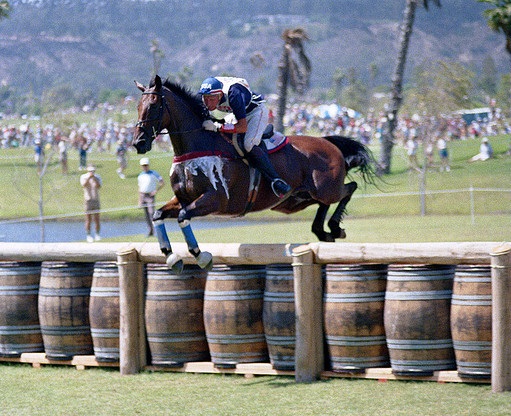
Easy peasy, lemon squeezy.Previously in the same chapter, Susan goes into why eventing is criticized. It is because of the things that go wrong, the missteps that cause a broken leg and euthanasia or a coma and brain damage. I understand that it’s part of all horse sports and life. I won’t preach to you on that just yet. But then she digs in deeper and quotes a director of the MSPCA (Massachusetts Society for the Prevention of Cruelty to Animals). “It’s not the eventing horses who have hard lives…it’s all those horses who sit in a field or stall doing nothing…” That is a rather brazen statement to me. I think that 95% of all horses are perfectly happy to sit in field and do nothing IF (and this is the “big if”) they have a sense of security and their physical needs are met. Do you suppose wild horses are unhappy? I think not! What do they have over a horse in a field? They actually have less than that horse. They have a herd, which makes them feel secure. They have space to move around and forage. They probably don’t get as much forage as they’d like, but I think I am safe to say that wild horses live a happy life. They’re certainly not moping around wishing that someone would come along and make them into their next Prix St. George/three foot jumper/national reiner/etc.
Via ValeeHill on Flickr
And already I feel like I am assigning human characteristics to an animal. I don’t think we can truly say when an animal is happy or sad. We are not them! We don’t know what emotions they feel and how deeply they feel them compared to us. We can only research and assume.

Via Melissa_Photos on Flickr
“Oh, I am so unhappy, I wish someone would ride me five days a week until I break a sweat and they’d give me treats and bathe me.”
I personally feel like a horse is equally as happy being a meticulously cared for four star event horse or being in a field rarely being touched by a human. Honestly, we humans care more than the horses do. Think about it.
Horse owner: “I’m going on vacation so I better put my horse in training to keep it in work so he doesn’t just sit in a field.”
95% of horses: “Yay, I get to sit here and eat all day with my friends!”
5% or less of horses: “Hm, no workout today. I kinda miss eating treats.”
And even then, some of those 5% just want human interaction/treats/being scratched, not the riding/working/sweating aspect.
Now if the horse is sitting in a barbed wire field alone, doing nothing, in feces up to its knees and not a blade of grass in sight? That’s a whole ‘nother story. That’s where my idea of security + food/water = happy horse comes in.

Via Vic_206 on Flickr
What I think “the good life” looks like for domesticated horses.
I could pull out more quotes and more of my own opinions, but I won’t, mostly because I didn’t save those places in the book and also because this post is going on for longer than you probably would like it to. (I got really good at going on and on about much of nothing during NaNoWriMo.)
I’m glad to know that I’m not the only person who works with and cares for horses so much that I know all these details that riders and sometimes even owners don’t know. Such as where a horse always poops in its stall, which ones come when you call and which ones will need some form of bribery, which ones will dart out the gate at any chance, they’re individual drinking habits, which treats it prefers, its pecking order in the herd, which horse will kick or bite your head off if you’re not careful, which ones fall asleep in the barn aisle not even tied, which ones will chew through lead ropes if they’re left hanging nearby, which ones will spook at a motorcycle and which ones will walk right past a rolling trash can. I know all of these horses and I am glad to know them in this manner. I wouldn’t have it any other way and I take pride in being their caretaker.
Tuesday, January 24, 2012
Omnomnom (treats!)
I’d
like to share a great horse cookie recipe that was passed along to me
by a friend of mine. They are super easy to make, which is why they
appealed to me in the first place! I am not a cook and not a baker.
Whenever I attempt cooking alone, something always goes wrong. I have
ruined many a dish. So when I say something is so simple I could make
it, it means something.
Yummy Horse Treats!
Ingredients:
2 cups dry oatmeal
1/3 cup finely chopped carrots
1 grated large apple
2 tablespoons of molasses or honey
½ cup brown sugar
Whole wheat flour or all-purpose flour
Crushed peppermint candy (optional)
If you want to make frosting for the cookies, you mix plain yogurt, oat flour, and food coloring together. (I didn’t try this.) Or you can melt marshmallows in the microwave and squish them in between two cookies. (I melted one on top of each cookie, but it made for a sticky mess.)

The best way for me to describe these is a healthy granola treat. I personally love them as a barn snack. Some for me, some for the horse! My horse doesn’t like peppermints and would not eat the first batch I made, so I took that out of the recipe to make her happy. The horses seemed to like it plain and with the marshmallow topping equally. I’m kind of getting hungry thinking of this… Make a batch, mail some to me, and tell me what your horses thought of them!
Yummy Horse Treats!
Ingredients:
2 cups dry oatmeal
1/3 cup finely chopped carrots
1 grated large apple
2 tablespoons of molasses or honey
½ cup brown sugar
Whole wheat flour or all-purpose flour
Crushed peppermint candy (optional)
- Preheat the oven to 365 degrees.
- Combine all ingredients except for the flour in a bowl. Add flour until you get enough consistency to form them into balls. (For me that was about 2 cups.)
- Put something on the cookie sheet to keep the cookies from sticking. (I used a cooking spray then dusted it with flour.) Make little balls with the dough and put them on the cookie sheet, pressing down on the tops slightly.
- Bake for 20 minutes or until the cookies are firm to the touch. (You can use a toothpick to poke them.)
If you want to make frosting for the cookies, you mix plain yogurt, oat flour, and food coloring together. (I didn’t try this.) Or you can melt marshmallows in the microwave and squish them in between two cookies. (I melted one on top of each cookie, but it made for a sticky mess.)

Clearly, Pony (Yvonne's newest project) loves treats.
Orr ..she thinks he does. She hasn't exactly given any to him yet. Oops!~
The best way for me to describe these is a healthy granola treat. I personally love them as a barn snack. Some for me, some for the horse! My horse doesn’t like peppermints and would not eat the first batch I made, so I took that out of the recipe to make her happy. The horses seemed to like it plain and with the marshmallow topping equally. I’m kind of getting hungry thinking of this… Make a batch, mail some to me, and tell me what your horses thought of them!
Monday, January 16, 2012
Why We Didn’t Watch The Kentucky Derby
This is what happened on the farm the day of the Derby. I recounted the epic event to
one of my friends in a chat window and this is how it went. Somehow there came to
be an alternate version during the telling of the story, which I thought some might find
entertaining. My friend’s replies to my story are in italics. Here is how it went down.

Okay, once upon a time, otherwise known as today, Isabel went out to catch Ivanna to ride her. Ivannasaurus is the massive fancy bay horse that we all like, but is terribly spooky and bucked me off once.
Fancy bay unicorn. Also Isabel is a princess. Continue with the story...
When Isabel went to buckle the halter, Ivanna spooked away from her and then Isabel couldn't get close to her again. Since Ivanna was in a thirty acre pasture with the rest of the dozen other mares. Isabel came and got me as backup. Ivanna was in the dry lot area with a few other mares, so we closed the gate and locked them in. Except the dry lot is kind of still big. We got up to Ivanna, but when we went to buckle the halter, she got away from us.
Now this is a horse who we've been working with since July NEVER had problems catching her. So we chased her around with the ATV to get her a little tired and tried again. Peg came over to join our ranks. Ivanna was soon huffing and puffing, so we stopped and tried to wrangle her again. One of us would try to go up to her and touch her and the other two would head her off if she tried to get away. It did not work. So we made a new plan. Next to the dry lot is a barn/shed where we store straw bales. There's a gate to the dry lot. We opened the gate, led two horses in and chased the others inside, hoping to get Ivanna into the smaller space, put out the others, and catch her there. She did not go in.
So the crazy unicorn was using her unicorn powers to evade the princesses’ attempts at catching and taming the majestic beast.
After more chasing with the four-wheeler, we decided that that plan needed to end and we needed a new one. Peg called us over and we went to a corner of the dry lot. We cornered Ivanna in the corner, and I held Renee' on one side of her and Isabel held Vanity on the other side of her, with their butts facing the fence. So we trapped her between the two mares.
And so the princesses realize they cannot combat the great unicorn's magical powers, so they decide to try and beat her at a game of wits.
Oh and I forgot to mention. We had an extra halter on the four-wheeler and Hazel walked over to it, grabbed the halter in her mouth, went up to Peg, who was trying to touch Ivanna and shook the halter at Peg like "here, just get this on her so we can stop running around" Anyways, back to the corner.
Lol I'm liking this story.
Hazel came over by me with Renee' to form an even more powerful wall. Then Ivanna decided to sneak past Renee's butt. Bad idea!
Oh no! Did they defeat the majestic unicorn and harness her powers for good?
I backed Renee' up to close the space and Renee' gave Ivanna's kneecap a light kick. Peg tried to touch Ivanna and Ivanna again tried to sneak past Renee'. Renee' gave her a good kick and Ivanna decided it was unwise to leave the corner. She tried to go behind Vanity, but the boss mare gave her the evil eye. Ivanna thought about jumping over the fence, but the electric fence zapped her. She looked at Renee' and Renee' cocked a hind hoof in warning. Ivanna looked back at the fence.
THE SUSPENSE IS KILLING ME.
Peg slowly but surely was able to touch Ivanna. She rubbed her neck and talked soothingly to her. She rubbed the halter on her sweaty dripping neck and worked it onto her face. Isabel handed her the lead rope and the dinosaur was captured!!! Then we put her in prison. Haha.
AND THE UNICORN BECAME A DINOSAUR didn't see that coming. Excellent twist!
The most bestest part was when Renee' was super powerful smart brain and kicked Ivanna to keep her from running away. And the second besty was when Hazel brought Peg the halter.
YOU CAN ALWAYS COUNT ON YOUR TRUSTY UNICORN SIDEKICKS (:


Okay, once upon a time, otherwise known as today, Isabel went out to catch Ivanna to ride her. Ivannasaurus is the massive fancy bay horse that we all like, but is terribly spooky and bucked me off once.
Fancy bay unicorn. Also Isabel is a princess. Continue with the story...
When Isabel went to buckle the halter, Ivanna spooked away from her and then Isabel couldn't get close to her again. Since Ivanna was in a thirty acre pasture with the rest of the dozen other mares. Isabel came and got me as backup. Ivanna was in the dry lot area with a few other mares, so we closed the gate and locked them in. Except the dry lot is kind of still big. We got up to Ivanna, but when we went to buckle the halter, she got away from us.
Now this is a horse who we've been working with since July NEVER had problems catching her. So we chased her around with the ATV to get her a little tired and tried again. Peg came over to join our ranks. Ivanna was soon huffing and puffing, so we stopped and tried to wrangle her again. One of us would try to go up to her and touch her and the other two would head her off if she tried to get away. It did not work. So we made a new plan. Next to the dry lot is a barn/shed where we store straw bales. There's a gate to the dry lot. We opened the gate, led two horses in and chased the others inside, hoping to get Ivanna into the smaller space, put out the others, and catch her there. She did not go in.
So the crazy unicorn was using her unicorn powers to evade the princesses’ attempts at catching and taming the majestic beast.
After more chasing with the four-wheeler, we decided that that plan needed to end and we needed a new one. Peg called us over and we went to a corner of the dry lot. We cornered Ivanna in the corner, and I held Renee' on one side of her and Isabel held Vanity on the other side of her, with their butts facing the fence. So we trapped her between the two mares.
And so the princesses realize they cannot combat the great unicorn's magical powers, so they decide to try and beat her at a game of wits.
Oh and I forgot to mention. We had an extra halter on the four-wheeler and Hazel walked over to it, grabbed the halter in her mouth, went up to Peg, who was trying to touch Ivanna and shook the halter at Peg like "here, just get this on her so we can stop running around" Anyways, back to the corner.
Lol I'm liking this story.
Hazel came over by me with Renee' to form an even more powerful wall. Then Ivanna decided to sneak past Renee's butt. Bad idea!
Oh no! Did they defeat the majestic unicorn and harness her powers for good?
I backed Renee' up to close the space and Renee' gave Ivanna's kneecap a light kick. Peg tried to touch Ivanna and Ivanna again tried to sneak past Renee'. Renee' gave her a good kick and Ivanna decided it was unwise to leave the corner. She tried to go behind Vanity, but the boss mare gave her the evil eye. Ivanna thought about jumping over the fence, but the electric fence zapped her. She looked at Renee' and Renee' cocked a hind hoof in warning. Ivanna looked back at the fence.
THE SUSPENSE IS KILLING ME.
Peg slowly but surely was able to touch Ivanna. She rubbed her neck and talked soothingly to her. She rubbed the halter on her sweaty dripping neck and worked it onto her face. Isabel handed her the lead rope and the dinosaur was captured!!! Then we put her in prison. Haha.
AND THE UNICORN BECAME A DINOSAUR didn't see that coming. Excellent twist!
The most bestest part was when Renee' was super powerful smart brain and kicked Ivanna to keep her from running away. And the second besty was when Hazel brought Peg the halter.
YOU CAN ALWAYS COUNT ON YOUR TRUSTY UNICORN SIDEKICKS (:

Monday, December 26, 2011
Merry Christmas!
Winter Wonderland - Sarah Remix
 Corgis bark, are you listening,
In the lane, snow is glistening
A beautiful sight,
We're happy to ride.
Working in a winter wonderland.
Gone away are the hoses
We forgot to drain the water
We can’t feel our toes
As we go along,
Working in a winter wonderland.
We have to take a look the waterers
It’s a bad sign if it’s empty
 When there’s ice on top we have to break it
But sometimes that can be a hard job.
Later on, we'll talk horses,
As we dine on the couches
To Facebook we post
Show plans that we've made,
Working in a winter wonderland.
In the meadow we can race our horses,
And pretend that it’s the Triple Crown
We'll have lots of fun being jockeys
Until the green young horse bucks us off.
When it snows, ain't it thrilling,
Watch the horses have fun rearing
They frolic and play, the Percheron way,
Working in a winter wonderland.
*Merry Christmas from Sarah at Rounder! I sincerely hope everyone is excited for lots more posts from her ..she's been writing a few& my lazy arse hasn't been posting them. I'm back in a groove now though so watch out!

In the lane, snow is glistening
A beautiful sight,
We're happy to ride.
Working in a winter wonderland.
Gone away are the hoses
We forgot to drain the water
We can’t feel our toes
As we go along,
Working in a winter wonderland.
We have to take a look the waterers
It’s a bad sign if it’s empty
 When there’s ice on top we have to break it
But sometimes that can be a hard job.
Later on, we'll talk horses,
As we dine on the couches
To Facebook we post
Show plans that we've made,
Working in a winter wonderland.
In the meadow we can race our horses,
And pretend that it’s the Triple Crown
We'll have lots of fun being jockeys
Until the green young horse bucks us off.
When it snows, ain't it thrilling,
Watch the horses have fun rearing
They frolic and play, the Percheron way,
Working in a winter wonderland.
*Merry Christmas from Sarah at Rounder! I sincerely hope everyone is excited for lots more posts from her ..she's been writing a few& my lazy arse hasn't been posting them. I'm back in a groove now though so watch out!
Monday, October 24, 2011
If You Love It, Let It Go
A lot of my good thinking
for writing happens in the shower or while I’m cleaning stalls. Today
it was the latter. I’ve been meaning to write a Rounder post for days,
but just hadn’t been hit with the right inspiration. I am a student, I am a learner.
If I do nothing else in life, I hope that I will always always learn.
Learn from my mistakes, learn from other’s mistakes and learn from
doing. Light bulb moments happen for riders, too!
I was having trouble with a mare I was getting ready to show. She’s fairly young and has only been under saddle for a year and a few months. She did the basics well. W/T/C, turning, stopping. She even leg yields, shoulder-ins, and is catching onto haunches-in/travers and walk pirouettes. I wasn’t having trouble with movements. The problem to me was that she was heavy. My reins felt like they were weighted with bricks and there was a constant pull on my hands. My trainer gave me a lesson and I voiced my concern over this “problem.” As it is mostly all of the time with horses, I found out that the problem was not the horse, it was me.
My trainer observed me riding the mare then began to teach me. I did as she instructed, and like a light bulb flickering before turning on, something in my head hit the switch. I had been living in the half-halt for too long. I had been pulling and holding, waiting for the release instead of softening through my elbows and having the horse give in the release.
BIG IDEA: The horse gives in the RELEASE not in the pull.
It doesn’t make sense in things other than horses. If you want to break a stick in half, you bend, push, and pull until it snaps. You don’t bend it down, let go, and then see it break on its own. But in horses, that is exactly what happens! You hold, drive, soften, and then the horse carries herself instead of relying on me to carry her. I was missing the last ingredient because it didn’t make sense in my head to let go when she hadn’t “broken” or given in to the pressure yet. I had been correcting her for leaning on the reins when all along I should have been addressing the pull factor. I was there for her when she wanted to lean, no wonder she thought the reins were for leaning on!
I don’t know that I am doing the best job of explaining this all, but as I was saying earlier, I am still in the process of learning this training stuff. Horses are animals, not static objects. Take loading a horse onto a horse trailer, for example. You don’t just set it on the ramp and pull it in. You want the horse to willingly comply to your asking them to step inside. The lead rope is used to convey this as well as your body language and voice. It’s a pull and release on the halter and notice that the horse steps forward after you have given the release, the slack in the rope. It is like fine tuning an instrument. Even the slightest, smallest movement can make a difference. A word of praise when the horse turns its head to focus on the task at hand, a sigh, and lowered head. Knowing just how much to give and take on the lead rope and knowing when to let them stand and touch the trailer floor or when to pull and urge them on.
You shouldn’t have to push and pull your horses around. You should strive to make them respect you and have them move into or out of your space as you instruct. Less is more. Learn from observing horse people (they don’t need to be a “trainer” to know what they are doing) who have learned from years and years of experience and have been under the instruction of other who have done the same. They know how to speak horse and they know how to get respect from them, no matter the shape, size, age, or training of the animal. Patience and timing. That is what they all have in common and that is what I need to learn. I wish there were more horse people in the world who understood horses as animals, not objects or human children. I hope to someday become one of them, no matter how long it takes to get there. You can too.
 *By the way, I
apologize for not putting up posts in due time. I have no excuse and I
will try to do better from now on. I struggle heavily with
procrastination and wanting to give you all my very best and not just a
paragraph full of rainbow unicorns, so it is just a matter of me getting
my act together and becoming a real author, not one who just dabbles
when they feel like it!
*By the way, I
apologize for not putting up posts in due time. I have no excuse and I
will try to do better from now on. I struggle heavily with
procrastination and wanting to give you all my very best and not just a
paragraph full of rainbow unicorns, so it is just a matter of me getting
my act together and becoming a real author, not one who just dabbles
when they feel like it!
I was having trouble with a mare I was getting ready to show. She’s fairly young and has only been under saddle for a year and a few months. She did the basics well. W/T/C, turning, stopping. She even leg yields, shoulder-ins, and is catching onto haunches-in/travers and walk pirouettes. I wasn’t having trouble with movements. The problem to me was that she was heavy. My reins felt like they were weighted with bricks and there was a constant pull on my hands. My trainer gave me a lesson and I voiced my concern over this “problem.” As it is mostly all of the time with horses, I found out that the problem was not the horse, it was me.
My trainer observed me riding the mare then began to teach me. I did as she instructed, and like a light bulb flickering before turning on, something in my head hit the switch. I had been living in the half-halt for too long. I had been pulling and holding, waiting for the release instead of softening through my elbows and having the horse give in the release.
BIG IDEA: The horse gives in the RELEASE not in the pull.
It doesn’t make sense in things other than horses. If you want to break a stick in half, you bend, push, and pull until it snaps. You don’t bend it down, let go, and then see it break on its own. But in horses, that is exactly what happens! You hold, drive, soften, and then the horse carries herself instead of relying on me to carry her. I was missing the last ingredient because it didn’t make sense in my head to let go when she hadn’t “broken” or given in to the pressure yet. I had been correcting her for leaning on the reins when all along I should have been addressing the pull factor. I was there for her when she wanted to lean, no wonder she thought the reins were for leaning on!
I don’t know that I am doing the best job of explaining this all, but as I was saying earlier, I am still in the process of learning this training stuff. Horses are animals, not static objects. Take loading a horse onto a horse trailer, for example. You don’t just set it on the ramp and pull it in. You want the horse to willingly comply to your asking them to step inside. The lead rope is used to convey this as well as your body language and voice. It’s a pull and release on the halter and notice that the horse steps forward after you have given the release, the slack in the rope. It is like fine tuning an instrument. Even the slightest, smallest movement can make a difference. A word of praise when the horse turns its head to focus on the task at hand, a sigh, and lowered head. Knowing just how much to give and take on the lead rope and knowing when to let them stand and touch the trailer floor or when to pull and urge them on.
You shouldn’t have to push and pull your horses around. You should strive to make them respect you and have them move into or out of your space as you instruct. Less is more. Learn from observing horse people (they don’t need to be a “trainer” to know what they are doing) who have learned from years and years of experience and have been under the instruction of other who have done the same. They know how to speak horse and they know how to get respect from them, no matter the shape, size, age, or training of the animal. Patience and timing. That is what they all have in common and that is what I need to learn. I wish there were more horse people in the world who understood horses as animals, not objects or human children. I hope to someday become one of them, no matter how long it takes to get there. You can too.

Wednesday, October 5, 2011
Rags to Regionals!
When I first arrived on the farm, I was quickly introduced to two young stallions. They were four and five at the time and had only been halter broke for a couple of months. One was steel gray and other was a faded bay. They were by the Oldenburg stallion, Routinier, and out of Percheron/Thoroughbred mares.
After a few days into my internship, I was taught how to lead them in and out from turnout and a stall in the barn where they were being taught to be tied and handled. It must have been a wet spring because the dry lot was deep with mud. The stallions didn’t seem to mind trading it for a dry stall bedded down with straw. I didn’t like leading the bay one into the barn because he would jump and spook at every little thing that seemed to be out of place in the aisle. The gray one, however, strode confidently past it all. I began round penning the both of them and teaching them how to wear tack. I should mention that I was also being taught how to do these things because I had never even touched a stallion before coming to the farm, let alone start a horse undersaddle. I had to call my trainer into the stall often when I was working with the bay one (turns out he is actually “seal brown”). The problem was that he wouldn’t let me pick up one of his hooves. In fact, he would raise the opposite foot and put all of his weight on the particular one I wanted to lift. Then he wouldn’t let me slide my finger into the side of his mouth in preparation for a bit. My work with him consisted of going into the stall with him, tying him to the post, and trying to pick up his feet and touch his mouth. Slowly, we progressed.

Another intern, who already was experienced with starting young horses undersaddle, soon came into the picture. She started both of the stallions, but made quicker progress with the bay horse. He was less prone to explosive bucking and was her favorite. I watched them work in the round pen while she explained to me what she was doing. She didn’t last long and when she left, I was suddenly in charge of riding the stallions. The stallions were flip-flopping it seemed and after getting bucked off of the gray one, I began to work solely with the other. He was calmer, beginning to understand his new job, although he was still a little frightened by it. I rode him in the round pen until I felt brave enough to come out into the arena. I still felt nervous when I went to canter him because all of a sudden, his head would drop to the ground, making his back round up beneath the saddle. A feeling similar to the hump (humpiness, humpy-ness?) before a bucking fit. But he never bucked. It was a while before I got him to canter with his nose not dragging in the sand. He made up for it by not being a wild stallion. In fact he was quite manageable. I just had to be careful not to scare him when correcting him for losing focus.
He had most of the winter off and although I did lunge him periodically, not much training happened during the coldest months. As it warmed up, the riding and training picked up as well. In May we stepped into the show ring for the first time. He had been under saddle for roughly nine months, if you didn’t include his winter vacation. To say I was nervous would be putting it lightly. Rocket was nervous too, as it was his first time off of the farm. I unloaded him and put him in his stall at the show barn and he stood there amidst the shavings and trembled. Aw… I lunged him and then had my trainer hold us on the lunge line as we hovered along, slowly gaining confidence along the way. Show day arrived bright and early. Rocket worked out of being introverted as the day continued on. He LOVES getting scratched on his neck and soon had a fan club of scratchers who would fawn over him after he did his tests.

As time does seem to slow when waiting for something important, it felt like twice as long, building up inch by inch to the regional championships. Qualifying proved to be easy and we got the scores we needed at our first recognized show. All we needed was more experience under our belt (and girth)! And experience did we get! FHF Rocketman and I went on to six shows altogether before regionals finally arrived. As we rode on the high of a very successful weekend of showing off, I took a few minutes to reflect on how far we had come in the past year. We both felt so much more confident in the show ring, like we both knew our jobs. Somehow, through all of the sweat and tears (and I’m not joking about either of those!), we had become a team. As they say in the dressage world, it felt like we were “harmonious.” It earned us fifth place in our Training Level championship class of twenty-nine competitors. I sure can’t complain about that (Yvonne here to say MAJOR congratulations to Miss Sarah)!

It felt good because the road had not been easy. After that first show, Rocket had blasted into full-fledged stallion mode and screamed at anything that moved and had hair. Even more unnerving? Just two weeks before regionals he started the trend of being backed off and acting like an obnoxious stallion. True to Rocket-style, he never did anything blatantly disobedient, but it was big for him when you consider that he never had acted up before with me. We worked through it both times, with a lot of coaching and pep talks for me. And this isn’t even mentioning all of the ups and downs that go along with showing. Like the time that Rocket feared for his very life when he saw a black and white pinto Gypsy cob stallion flailing hair everywhere and all the times I for sure thought my heart would stop beating and I would die right there in the saddle. As we stood in the line-up of eight horses with a pink ribbon on our bridle, I couldn’t help but feel proud as Rocket trembled beneath me and tried to leave the arena.

I can’t wait to see what next year brings! (And I am so utterly grateful for this wonderful opportunity to ride, train, and show such a talented young horse.)
Monday, September 12, 2011
Trail time!
In my intro post, I briefly touched on the subject matter of my horse
at home. What I didn’t mention was that I have a pony here at the farm
I’m interning at (a real pony, not a horse sized animal that I fondly
call “pony”). She is my training project and not intended for keeps. At
the moment, I’m trying to expose her to a little bit of everything, so
when I got the chance to take her on a trail ride, I jumped at it. The
only incident of the otherwise perfect day was that I forgot that little
Sadie didn’t know how to back out of a straight load trailer.
The only other time I unloaded her was when I bought her in freezing cold February and we just opened the partition and let her turn around so we could get her out and go back to the warmth of the house. Anyways, I watched the other horse unload like a pro, undid the butt bar and untied Sadie, expecting her to do the same. She did what she had been taught, turn around and walk out. Or at least she tried to. The trailer shook only slightly (she’s not big enough to rock it very much) then stopped as she realized even she was not small enough to turn around in the slot. It was then that I remembered that she didn’t know how to back out of a trailer. Oops. I took my time and showed Sadie how to unload.
Once that was dealt with, everything went smoothly. We tacked up, covered the horses and ourselves in bug spray (Sadie handled the aerosol spray can without batting an eyelash) and headed for the trails! The park was well cared for and very pretty. I was thrilled when I discovered that 95% of our riding was done in the shade. The trail was only wide enough for a single file line in most places, so we took turns leading and following. Mecca, the Clydesdale/Thoroughbred cross whose owner is the one that invited us to trail ride with her, took the lead when we were unsure of our way back to the trailer and she picked the correct and most direct way each time. It was cool watching her figure it out and I felt very confident in her bloodhound skills.

While Sadie and Mecca didn’t talk much (Or at all really, other than their telepathic messages… just kidding!), their riders chatted almost the whole time. One of the things we briefly talked and agreed upon was the headset that we find acceptable on the trail versus what we expect when we are working on our dressage in the ring. When riding at home in the arenas, we work at making our horses supple (bending in whatever direction we ask for during any movement or gait we are doing) and round (not just a headset here, roundness comes from behind, remember my recycling post). When on the trail, although we often have a light connection on the reins to the bit, we allow our horses to look around and observe their surroundings. We do not, however, allow them to become so intently focused on something that they lose their attentiveness to their rider and the trail that we are traveling (it is like Sally Swift’s concept of having soft, not hard, eyes while riding. We do not want our horse to get hard eyes while trail riding). We also expect our horses to remain bendable. I feel strongly that if your horse is bendable and attentive to you, you will be able to practice safe trail riding.
On the other hand, if your horse keeps zoning in on potentially scary things and has a neck as stiff as a board… let's just say that I hope you’re wearing a helmet! What are your expectations of your horse’s body and mind while trail riding?
After almost two hours of walking, trotting, and cantering, we came back to the trailer, grinning and gushing about how wonderful the weather was and how we had the best trail mounts. The horses enjoyed some hay while we riders had a lovely picnic. Altogether it was a completely enjoyable experience and I look forward to going out and about with the pony again.

Here’s a handy trail riding tip for you. When rising/posting the trot on the trail, make sure to alternate posting on either diagonal. I did this without thinking because of my very slight OCD (if you even want to call it that), but it was pointed out to me that your horse may become sore if you post the whole ride on just one diagonal. So switch it up!

P.S. When we returned to the barn, Sadie unloaded like she’d been backing out of trailers for years ..what a smart pony ;)
The only other time I unloaded her was when I bought her in freezing cold February and we just opened the partition and let her turn around so we could get her out and go back to the warmth of the house. Anyways, I watched the other horse unload like a pro, undid the butt bar and untied Sadie, expecting her to do the same. She did what she had been taught, turn around and walk out. Or at least she tried to. The trailer shook only slightly (she’s not big enough to rock it very much) then stopped as she realized even she was not small enough to turn around in the slot. It was then that I remembered that she didn’t know how to back out of a trailer. Oops. I took my time and showed Sadie how to unload.
Once that was dealt with, everything went smoothly. We tacked up, covered the horses and ourselves in bug spray (Sadie handled the aerosol spray can without batting an eyelash) and headed for the trails! The park was well cared for and very pretty. I was thrilled when I discovered that 95% of our riding was done in the shade. The trail was only wide enough for a single file line in most places, so we took turns leading and following. Mecca, the Clydesdale/Thoroughbred cross whose owner is the one that invited us to trail ride with her, took the lead when we were unsure of our way back to the trailer and she picked the correct and most direct way each time. It was cool watching her figure it out and I felt very confident in her bloodhound skills.

While Sadie and Mecca didn’t talk much (Or at all really, other than their telepathic messages… just kidding!), their riders chatted almost the whole time. One of the things we briefly talked and agreed upon was the headset that we find acceptable on the trail versus what we expect when we are working on our dressage in the ring. When riding at home in the arenas, we work at making our horses supple (bending in whatever direction we ask for during any movement or gait we are doing) and round (not just a headset here, roundness comes from behind, remember my recycling post). When on the trail, although we often have a light connection on the reins to the bit, we allow our horses to look around and observe their surroundings. We do not, however, allow them to become so intently focused on something that they lose their attentiveness to their rider and the trail that we are traveling (it is like Sally Swift’s concept of having soft, not hard, eyes while riding. We do not want our horse to get hard eyes while trail riding). We also expect our horses to remain bendable. I feel strongly that if your horse is bendable and attentive to you, you will be able to practice safe trail riding.
On the other hand, if your horse keeps zoning in on potentially scary things and has a neck as stiff as a board… let's just say that I hope you’re wearing a helmet! What are your expectations of your horse’s body and mind while trail riding?
After almost two hours of walking, trotting, and cantering, we came back to the trailer, grinning and gushing about how wonderful the weather was and how we had the best trail mounts. The horses enjoyed some hay while we riders had a lovely picnic. Altogether it was a completely enjoyable experience and I look forward to going out and about with the pony again.

Here’s a handy trail riding tip for you. When rising/posting the trot on the trail, make sure to alternate posting on either diagonal. I did this without thinking because of my very slight OCD (if you even want to call it that), but it was pointed out to me that your horse may become sore if you post the whole ride on just one diagonal. So switch it up!

P.S. When we returned to the barn, Sadie unloaded like she’d been backing out of trailers for years ..what a smart pony ;)
Monday, September 5, 2011
New surroundings
I’d like to introduce you to a new randomly occurring feature here at
Rounder! I have dubbed it “A Photo With A Story”, which I think that is
fairly self-explanatory. For now, I plan to use it as an outlet for
eventually getting to tell the story in bits and pieces of my first and lifer horse. But who knows where we’re rowing or which way the
river’s flowing, wait, wrong movie, sorry! Haha, okay so onto the real
content, I promise.
For a long time, (I’m not sure how long, but for years okay) I wanted to ride in an indoor arena, just to experience it. Since Hawaii does not have seasons in the traditional sense, an indoor is not eminent to riding in the wintertime. Until I came to Indiana, I rode outside or not at all. There was no try. I mean, no middle ground. I’ve even ridden on days that were supposed to have a hurricane and tsunami (not the same day, thankfully). My point is, weather on my island is mild. The most people will do is have a covered arena. In my mind that was second best next to an actual indoor arena with walls. Once I bought my horse, my dream to ride in an indoor expanded into specifically riding her in an indoor arena. Yeah, I reach for the sky.
I knew of only one covered arena on the island. I looked at it intently every time we drove out of town. It is located on the “wet side” where it rains so often that mold discolors the sides of houses. (My town has a “wet side” and "dry side” and we refer to it as such. But that’s off the topic of horses, so I’ll let it go.) I suppose the owners wanted to be able to ride and hold events without getting wet. Makes sense. I did not realize that the community college had built a newer covered arena for their budding equestrian team. I found out about it when my barn owner told me that she was going to do a vaulting demonstration there with the vaulting team she had organized. I quickly peeped up “Can I come along and bring Miss Take to keep Roxy company?” Roxy was the Shire/Percheron that the kids did their vaulting maneuvers on and was not as versed in travel as my horse was. I was super excited when I got the okay and started imagining how my horse would react to being ridden in a covered arena.

Although I had taken my horse to the two venues on our island that held dressage shows, it did not count as going to a “new place” because she had already been to one of those places in the past and had actually lived at the other place before coming to my barn. So I had never experienced how my horse reacted to new surroundings. I wasn’t sure what to expect. Miss Take, or Miss T as we fondly call her, had begun to develop a certain degree of trust in me. She only spooked with me if there was a plastic bag whipping in the wind or a sheaf of papers blew at her feet (or that one time that she thought a lone calf was running straight for us). And even those spooks were getting smaller and smaller. Despite her placid nature, I knew that she also had more of a timid side as opposed to being naturally brave and confident. I wasn’t sure if I should expect my usual saint of a horse, a frightened mare, or something in between.

For a long time, (I’m not sure how long, but for years okay) I wanted to ride in an indoor arena, just to experience it. Since Hawaii does not have seasons in the traditional sense, an indoor is not eminent to riding in the wintertime. Until I came to Indiana, I rode outside or not at all. There was no try. I mean, no middle ground. I’ve even ridden on days that were supposed to have a hurricane and tsunami (not the same day, thankfully). My point is, weather on my island is mild. The most people will do is have a covered arena. In my mind that was second best next to an actual indoor arena with walls. Once I bought my horse, my dream to ride in an indoor expanded into specifically riding her in an indoor arena. Yeah, I reach for the sky.
I knew of only one covered arena on the island. I looked at it intently every time we drove out of town. It is located on the “wet side” where it rains so often that mold discolors the sides of houses. (My town has a “wet side” and "dry side” and we refer to it as such. But that’s off the topic of horses, so I’ll let it go.) I suppose the owners wanted to be able to ride and hold events without getting wet. Makes sense. I did not realize that the community college had built a newer covered arena for their budding equestrian team. I found out about it when my barn owner told me that she was going to do a vaulting demonstration there with the vaulting team she had organized. I quickly peeped up “Can I come along and bring Miss Take to keep Roxy company?” Roxy was the Shire/Percheron that the kids did their vaulting maneuvers on and was not as versed in travel as my horse was. I was super excited when I got the okay and started imagining how my horse would react to being ridden in a covered arena.

Although I had taken my horse to the two venues on our island that held dressage shows, it did not count as going to a “new place” because she had already been to one of those places in the past and had actually lived at the other place before coming to my barn. So I had never experienced how my horse reacted to new surroundings. I wasn’t sure what to expect. Miss Take, or Miss T as we fondly call her, had begun to develop a certain degree of trust in me. She only spooked with me if there was a plastic bag whipping in the wind or a sheaf of papers blew at her feet (or that one time that she thought a lone calf was running straight for us). And even those spooks were getting smaller and smaller. Despite her placid nature, I knew that she also had more of a timid side as opposed to being naturally brave and confident. I wasn’t sure if I should expect my usual saint of a horse, a frightened mare, or something in between.

Covered arena? Meh. Give me more carrots!
How does your horse react to new environments and surroundings?!
Subscribe to:
Posts (Atom)
